Footwear pricing strategy became one of the most important lessons I learned as a footwear manufacturer when India’s GST structure changed and raw-material costs later came under pressure from global geopolitical uncertainty.
A real manufacturing case study on pricing strategy, buyer margins, raw-material inflation and business resilience
The GST Shock
September 22, 2025
The government reduced GST on applicable footwear from 12% to 5%.
Most businesses naturally think:
GST reduced → selling price should reduce.
But I looked at it differently.
I decided not to immediately reduce my MRP or basic market price.
Instead, I passed the benefit through the trade channel by giving my buyers additional margin.https://www.loansjagat.com/gst/gst-on-footwear
My thinking was:
Keep MRP stable + improve buyer margin = stronger distribution relationship + pricing flexibility
This made my buyers happy because they received better commercial margins.
At the same time, I didn’t have to immediately redesign my entire pricing structure.
Why I Didn’t Reduce MRP
Changing MRP is not just changing one number.
It can affect:
- Printed boxes
- Product catalogues
- Price lists
- Dealer communication
- Distributor expectations
- Retailer pricing
- Existing stock
- Market positioning
So instead of permanently reducing the headline price, I created additional margin as a buffer.
I didn’t look at the GST reduction as an opportunity to permanently reduce my price. I looked at it as an opportunity to create flexibility in my pricing structure.
Then the Environment Changed
This is where we bring in the US–Iran conflict.
After the GST decision, the business environment changed dramatically.
The US–Iran conflict created another problem for manufacturers: input-cost uncertainty.
The effects were not limited to oil.
Energy prices, shipping routes, freight costs and several commodity-linked inputs came under pressure. Indian manufacturers across sectors reported higher input costs and supply-chain uncertainty.https://shoesandaccessories.in/footwear-industry-feels-the-heat-of-iran-us-war-disruptions/
The decision that looked like a simple GST pricing decision months earlier suddenly became useful when the cost environment changed.
Business conditions don’t change only because of taxes and raw-material prices. Seasonal demand can also have a major impact on purchasing, inventory and cash flow. I explored this in my earlier case study on seasonal business demand.https://junedsiddiqui.com/seasonal-business-demand/?utm_source=chatgpt.com
Raw-Material Prices Started Moving
As a footwear manufacturer, I started seeing frequent changes in the cost of raw materials and other inputs. Prices were not moving once and settling. They were changing repeatedly, making costing and pricing decisions much more difficult.
Raw material cost ↑
Manufacturing cost ↑
Freight/logistics uncertainty ↑
Margin pressure ↑
But MRP was still unchanged.
The Footwear Pricing Strategy I Used
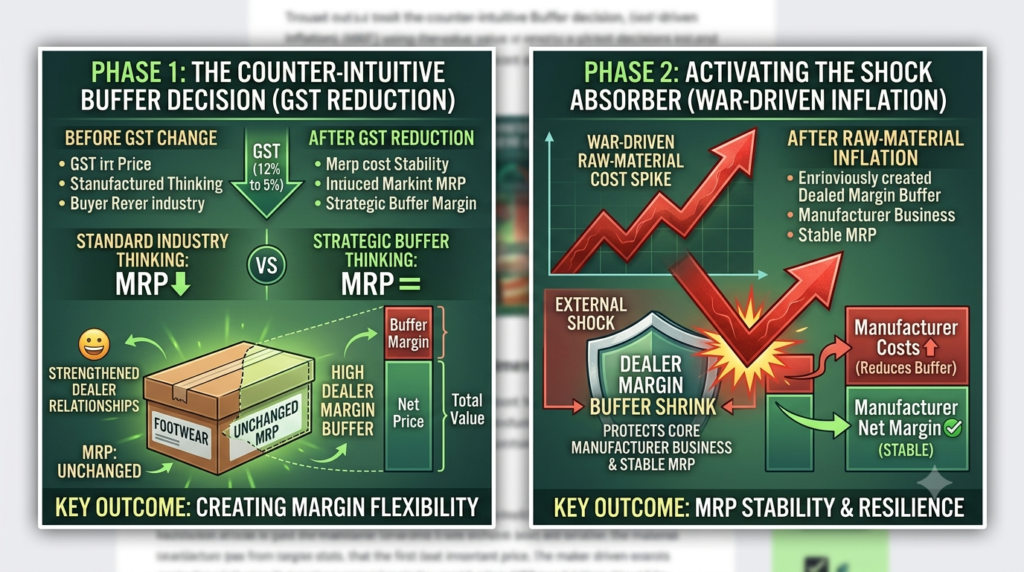
I had two choices:
Option A
Increase MRP and selling price.
Option B
Use the additional margin that had previously been given to buyers as a buffer.
I chose Option B.
Instead of immediately increasing MRP, I started removing the extra discount/margin that you had introduced after the GST reduction.
So the entire strategy becomes:
BEFORE GST CHANGE
Normal MRP
↓
Normal buyer margin
↓
Normal selling price
AFTER GST REDUCTION
Same MRP
↓
Higher buyer margin
↓
Market price remains stable
AFTER RAW-MATERIAL INFLATION
Same MRP
↓
Extra margin gradually reduced
↓
Manufacturer absorbs less cost pressure
The Strategy Worked in Both Directions
“I didn’t increase my price.”
I created flexibility when conditions were favorable and used that flexibility when conditions became difficult.
GST benefit → buyer margin
And later used that margin in the opposite direction:
Cost inflation → reduce extra discount
Without immediately changing MRP.
What the US–Iran Conflict Taught Me
Before this experience, I mostly looked at raw-material prices as a costing issue. But this experience changed the way I thought about footwear pricing strategy and business resilience.
After experiencing the impact of geopolitical uncertainty, I started looking at them differently.
A war thousands of kilometres away can eventually reach a small factory through fuel, freight, chemicals, polymers, packaging and other inputs.
And it is not just theoretical. Indian reporting has documented how the conflict’s energy and shipping effects spread into sectors beyond oil and gas, including manufacturing and petrochemical-linked industries
What My Footwear Pricing Strategy Taught Me About MRP
Real Invoice Comparison: How the Margin Buffer Worked
The strategy was not theoretical. These two real invoices show how I used the additional margin created after the GST reduction and later adjusted that margin when raw-material costs increased.
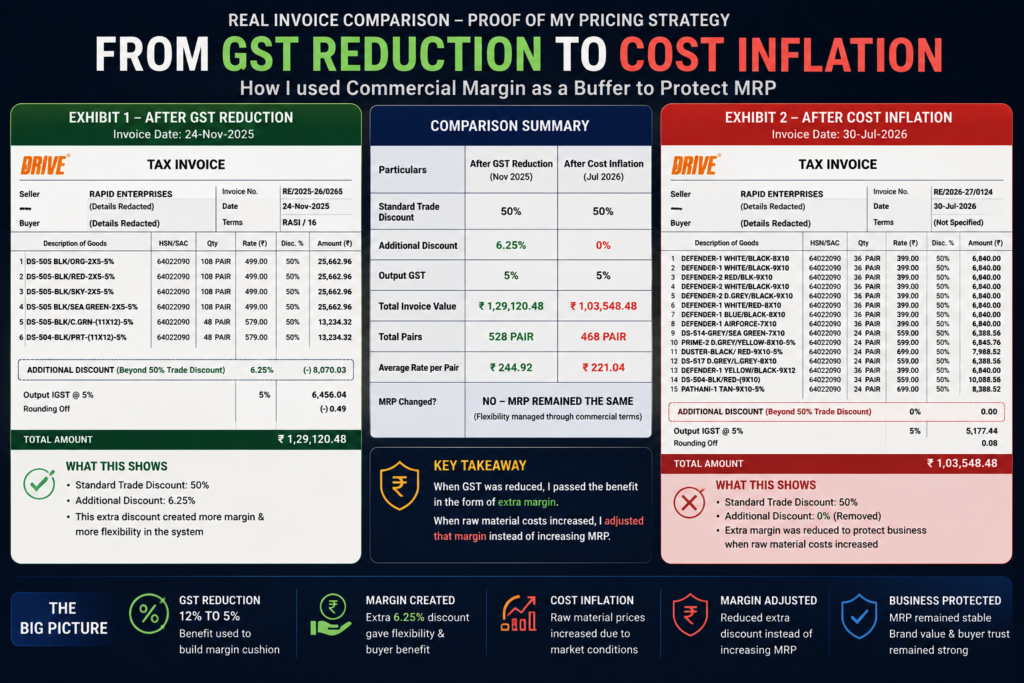
In the first invoice, the additional discount created a margin buffer while the MRP remained unchanged. When input costs later increased, I reduced that additional discount instead of immediately increasing MRP. This gave me flexibility to protect the business while maintaining market stability.
MRP should not always be the first lever you move.
A manufacturer can have several levers:
- MRP
- Trade discount
- Dealer margin
- Promotional discount
- Product mix
- Payment incentives
- Quantity incentives
- Cost control
discount can sometimes act as a shock absorber.
But There Is a Limit
We should also show the other side.
This strategy worked because I had previously created some margin flexibility. But that does not mean a manufacturer can keep absorbing rising costs forever.
This is also why business growth cannot be judged only by sales. Cash flow, margins, working capital and cost control can quietly determine whether growth is actually healthy. I have written about some of these common problems in my article on business growth mistakes.https://junedsiddiqui.com/5-business-growth-mistakes-that-quietly-kill-companies/?utm_source=chatgpt.com
If raw-material inflation continues for too long:
Margin ↓
Cash flow pressure ↑
Working capital requirement ↑
Business sustainability ↓
At some point, a price increase may become necessary.
My Biggest Lesson
My biggest lesson was not about GST. It was not even about the US–Iran conflict. It was about building flexibility into my footwear pricing strategy before the next market shock arrived.
It was about flexibility.
When the market gave me an opportunity, I created a buffer instead of immediately changing my price.
When the market later became difficult, I used that buffer instead of immediately passing the entire cost increase to my buyers.
That experience taught me that a good pricing strategy is not simply about maximizing today’s profit.
It is about creating enough flexibility to handle tomorrow’s uncertainty.