Integrating AI for business operations has become a practical part of my daily work. I don’t rely on AI for business tasks just to write emails or generate ideas. In my footwear business, I use AI for product creation, marketing, advertising, business planning, travel planning and as a thinking partner when I face difficult business decisions.
I am still experimenting, and I am still discovering new ways to use AI in my business every week.
I use AI to create product photos and videos.
I use it to plan advertising ideas.
I use it when I am planning a business trip.
I ask it to help me think through difficult business problems.
I use AI-powered tools to optimize my Amazon advertising campaigns.
I use it to analyze and improve my Flipkart advertising strategy.
And sometimes, I simply open AI and say:
“I have this problem. What should I do?”
For me, that is where AI becomes much more interesting.
It is not just a content-generation tool.
It is becoming a business thinking partner.
AI Is Becoming My Second Brain
Running a business means making hundreds of decisions.
Some decisions are big:
- Should I increase the price?
- Should I enter a new market?
- Should I increase advertising?
- Should I travel to meet new buyers?
- Should I accept a particular business deal?
Some decisions are much smaller:
- Which product photo should I use?
- What should my advertisement say?
- How should I present a product?
- Which campaign should receive more budget?
- How should I reply to a buyer?
The problem is that a business owner does not always have a specialist sitting beside him for every decision.
This is where I have started using AI.
I don’t treat AI as someone who will make every decision for me.
I treat it more like a second brain that helps me think.
I give it the problem.
I give it the numbers.
I explain the situation.
Then I ask it to challenge my thinking, give me options and explain the risks.
The final decision is still mine.
1.How I Use AI for Business Product Photography
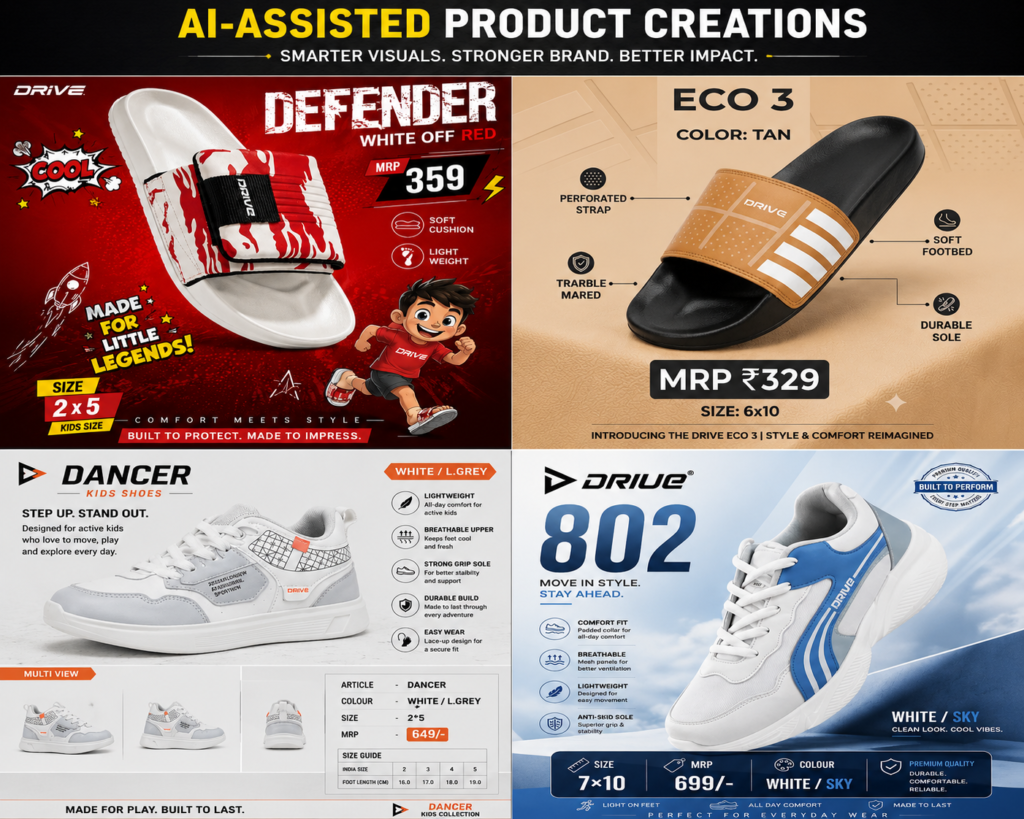
For me, the biggest advantage is speed. Earlier, creating multiple product concepts required more time, coordination and design work. With AI, I can explore several creative directions much faster. But I still decide what looks right for my brand, what information is accurate and which creative should actually be used in the market.
Footwear is a visual business.
Before a customer reads the description, they see the product.
Earlier, creating professional product visuals could require photography, models, locations, lighting, editing and multiple revisions. https://junedsiddiqui.com/wp-content/uploads/2026/07/Drive-Footwear-Catalogue.pdf
Today, AI can dramatically speed up the creative process.
I can take a basic product photograph and use AI-assisted workflows to create different visual concepts.
For example:
- A premium studio presentation
- A lifestyle image
- A fashion-oriented presentation
- Different backgrounds
- Different angles
- Promotional creatives
- Marketplace advertising images
This doesn’t mean that every AI image should automatically be used.
The product still has to look like the real product.
But AI has changed the speed at which I can experiment.
2. I Use AI to Create Product Videos
A real example of how I use AI-assisted tools to create marketing content for my footwear products.
The same thing is happening with video.
Short product videos are becoming increasingly important for online selling and social media.
AI helps me think about:
- Video concepts
- Scripts
- Product demonstrations
- Scene ideas
- Hooks
- Voiceovers
- Captions
- Different versions of the same advertisement
Instead of producing one video and hoping it works, I can think in terms of experimentation.
One product can have several creative concepts.
One concept can have several hooks.
One hook can have several versions.
AI makes this experimentation much faster.
3. I Use AI for Advertising Ideas
One of the biggest changes for me is how I think about advertising.
Earlier, I might look at a product and ask:
“How should I advertise this?”
Now I can ask AI much more specific questions.
For example:
“This is my footwear product. The MRP is ₹399. My target customer is value-conscious. Give me five advertising angles.”
Then I can continue:
“Which one is likely to create curiosity?”
Then:
“Give me three different ad concepts.”
Then:
“Write the video script.”
Then:
“Give me the visual direction.”
AI becomes part of the entire creative process.
Instead of using AI for one task, I use it to move from:
Idea → Strategy → Creative → Advertisement
4. I Use AI for Amazon Advertising
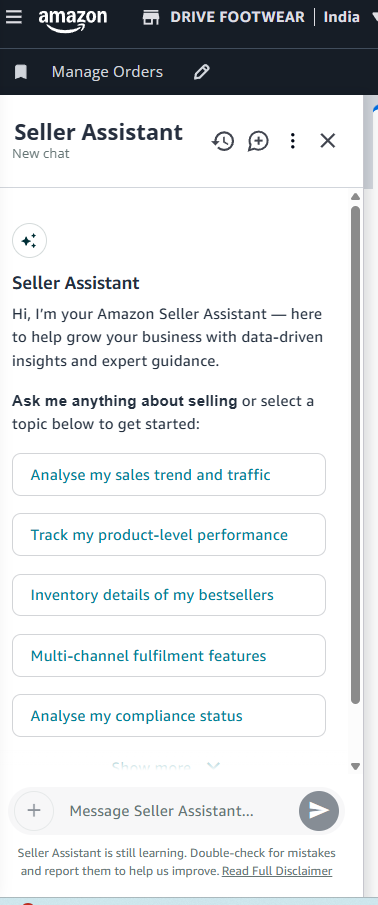
AI is not only helping me create advertising creatives. I am also starting to use AI directly inside the marketplaces where I sell. Amazon’s Seller Assistant is one example. https://amzn.in/d/08WNOAQz
What I find interesting is that I don’t have to use AI only through a separate AI application. AI is increasingly becoming part of the platforms where I already run my business. Amazon’s Seller Assistant can help me investigate questions about sales trends, product-level performance, inventory and other seller-related areas directly inside the seller environment.
I use an AI-powered Amazon advertising tool called SellerGeni to help optimize my campaigns.
SellerGeni describes its platform as an AI-powered Amazon advertising and campaign optimization system, including campaign optimization, keyword optimization, reporting and automated optimization capabilities.
The important lesson for me is not simply that an AI tool can change a bid.
The bigger lesson is that data can be turned into decisions faster.
Instead of looking at a large amount of campaign information and trying to understand everything manually, AI-powered tools can help identify areas that deserve attention.
That allows me to spend more time thinking about the business and less time doing repetitive analysis.
5. Using AI and Smart Automation for Flipkart Advertising
I also use AI-driven and automated tools inside Flipkart Seller Hub to help me manage advertising campaigns. Instead of treating advertising as simply spending money to get more clicks, I look at the campaign data to understand whether the advertising is actually generating commercially useful results.
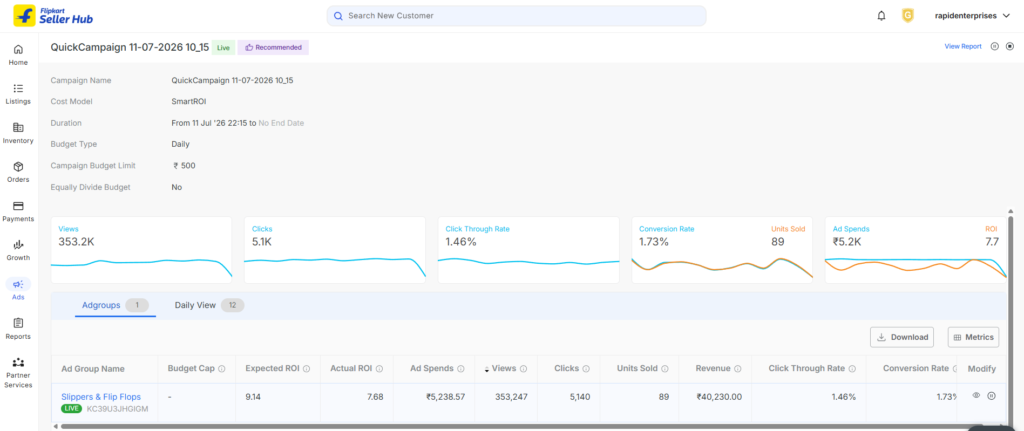
A real Flipkart SmartROI campaign from my footwear business, showing campaign performance, advertising spend, sales and ROI. https://share.google/JUqAgHI0O5Yyen23K
In this campaign, Flipkart’s SmartROI model was being used with a daily campaign budget of ₹500. The dashboard showed 353,247 views, 5,140 clicks, 89 units sold and ₹40,230 in attributed revenue against ₹5,238.57 in ad spend. The reported actual ROI was 7.68, compared with an expected ROI of 9.14.
But I don’t consider the dashboard’s ROI number to be the whole story. I still need to look at the products being promoted, their margins, conversion performance, inventory position and whether the resulting sales are profitable for my business. This is where I find AI and automated advertising systems useful: they can process large amounts of campaign data and optimize within their rules, while I remain responsible for the larger business decision.
For me, AI-powered advertising is not about handing over control. It is about making better decisions with more information.
AI doesn’t magically solve the campaign.
But it helps me think through the problem systematically.
And that is extremely valuable.
6. How AI for Business Functions as My Strategic Mentor
This may actually be my favourite use of AI.
Sometimes I don’t need a photo.
I don’t need a video.
I don’t need an advertisement.
I just have a problem.
For example:
“My sales have slowed down. What could be causing it?”
I can explain the situation to AI.
Then I can ask:
“Don’t just give me generic advice. Think like an experienced footwear business owner and challenge my assumptions.”
That changes the conversation.
I can ask AI to look at a problem from different perspectives:
Think like a CFO.
Think like a sales manager.
Think like a marketing expert.
Think like a buyer.
Think like my competitor.
Think like a business coach.
Suddenly, one problem can be examined from multiple angles.
This doesn’t replace experience.
But it can help me see things I might have missed.
7. I Use AI When Planning Business Trips
Business travel is another interesting example.
If I am planning a business trip, I can ask AI to help structure the trip around business objectives.
Instead of simply asking:
“What should I visit?”
I can ask:
- Which markets should I prioritize?
- What type of buyers should I meet?
- What should be my meeting objective?
- What questions should I ask?
- What information should I collect?
- How should I follow up?
- What should I prepare before travelling?
The trip becomes more than travelling.
It becomes a business mission.
AI helps me prepare before I leave.
8. I Use AI to Prepare Seller Proposals and Negotiation Strategies
Another powerful use is preparing for negotiations.
Suppose I have a buyer who wants a better price.
Instead of immediately saying yes or no, I can explain the complete situation to AI.
For example:
- Product cost
- MRP
- Current selling price
- Buyer quantity
- Payment terms
- Delivery requirements
- Expected repeat orders
- My minimum acceptable margin
Then I can ask:
“Act as an experienced B2B sales manager. Help me structure the best proposal for this buyer.”
AI can help me create:
- A seller proposal
- Different pricing options
- Negotiation points
- Payment-term options
- Quantity-based offers
- Follow-up messages
- Objection-handling responses
The most useful part is that I can ask:
“What should I offer without unnecessarily reducing my margin?”
That is a much better question than simply:
“Give me a discount.”
9. AI Helps Me Turn Problems Into Questions
This may be the biggest lesson I have learned.
A business problem is often difficult because we don’t know how to break it down.
For example:
Problem: Sales are down.
Instead of stopping there, I can ask AI to break the problem into:
- Traffic
- Conversion
- Pricing
- Product
- Competition
- Reviews
- Advertising
- Inventory
- Seasonality
- Market conditions
Now I have ten questions instead of one huge problem.
And once the problem is broken down, finding a solution becomes much easier.
10. But I Don’t Let AI Make the Final Decision
This is extremely important.
AI can be wrong.
AI can misunderstand the situation.
AI doesn’t automatically know my factory, my buyers, my cash flow, my relationships, my market or the realities of my business.
So I don’t want AI to become my boss.
I want AI to become my advisor.
There is a big difference.
I use AI to:
Think.
Question.
Analyze.
Compare.
Create.
Plan.
But I decide.
That human judgment is still extremely important.
AI Is Not Just About Saving Time
When people talk about AI, they often talk about productivity.
“AI can save you two hours.”
That’s true.
But I think there is something bigger happening.
AI can reduce the distance between an idea and execution.
Earlier:
Idea → Find expert → Explain problem → Wait → Get answer → Execute
Now:
Idea → Ask AI → Improve idea → Execute
That speed matters in business.
If I can test five ideas instead of one, I have more chances of finding something that works.
If I can analyze a problem in 20 minutes instead of two hours, I can make decisions faster.
If I can create ten creative concepts instead of two, I can experiment more.
AI is therefore not only a productivity tool.
For me, it is becoming an experimentation tool.
My AI Business Workflow
Today, my workflow increasingly looks something like this:
1. I identify a problem.
↓
2. I explain the situation to AI.
↓
3. AI helps me break the problem down.
↓
4. I ask for different strategies.
↓
5. I challenge the suggestions.
↓
6. I choose what makes sense for my business.
↓
7. I execute.
↓
8. I look at the result.
↓
9. I go back to AI and ask what I learned.
This creates a continuous learning loop.
Problem → AI → Decision → Action → Result → Learning
And I believe this is where AI becomes truly powerful for entrepreneurs.
The Future Belongs to Business Owners Who Know How to Use AI
I don’t believe AI will automatically make every entrepreneur successful.
Owning AI tools is not enough.
Knowing how to ask better questions is not enough either.
The real advantage comes from combining:
Business experience + Data + AI + Human judgment + Execution
A person who understands their business deeply and knows how to use AI can potentially move much faster than someone who uses AI only to write emails or generate social media captions.
That is the direction I am personally moving toward.
I am still learning.
I am still experimenting.
And I am still discovering new ways to use AI in my business every week.
But one thing has already become clear to me:
I don’t see AI as a replacement for the entrepreneur.
I see AI as the entrepreneur’s second brain.
And perhaps the biggest advantage is not that AI gives me all the answers.
It is that AI gives me the ability to ask better questions.