Seasonal demand can create major opportunities for manufacturers, but capturing that demand requires careful planning before the peak season arrives.
When a major festive or seasonal selling period is still months away, it is easy for a manufacturer to think there is plenty of time.
The peak season may seem far away on the calendar.
But manufacturers cannot plan only by looking at the date of the festival or the date when consumers are expected to start buying.
The more important question is:
“When does my customer need the product?”
That question changes the entire way a manufacturer should think about seasonal demand.
A customer may need the product weeks before the peak selling period. Before that, the wholesaler may need to receive the stock. Before that, the manufacturer needs to dispatch it. Before dispatch, production has to be completed. And before production can begin, raw materials have to be available.
This means that seasonal demand planning should work backward from the customer’s deadline.
THE CUSTOMER SEES THE SEASON. THE MANUFACTURER SEES THE LEAD TIME.
For a consumer, a festival or peak season may appear to be a single event.
For a manufacturer, it is a supply-chain process.
The flow can look like this:
Peak consumer demand
↓
Retailer prepares inventory
↓
Wholesaler purchases stock
↓
Transportation
↓
Manufacturer dispatches
↓
Production
↓
Raw-material procurement
↓
Supplier production
Every stage requires time.
If one stage starts late, the pressure moves to every stage that comes after it.
This is why a manufacturer can be busy preparing for a season long before the customer sees any significant increase in demand.
1. START WITH THE CUSTOMER’S DEADLINE
The first mistake is to start planning from the festival date.
Instead, start with the question:
“When must my customer have the stock in their warehouse or store?”
That date is much more useful.
A retailer may want to have most of its seasonal inventory ready before the peak selling period begins. A wholesaler supplying that retailer will therefore need the stock earlier.
The manufacturer has to work backward from that requirement.
This is particularly important when products are being transported across long distances.
A manufacturer in one region may be supplying wholesalers several hundred or thousands of kilometres away. Transportation can become a significant part of the total lead time.
2. CALCULATE TRANSPORTATION LEAD TIME
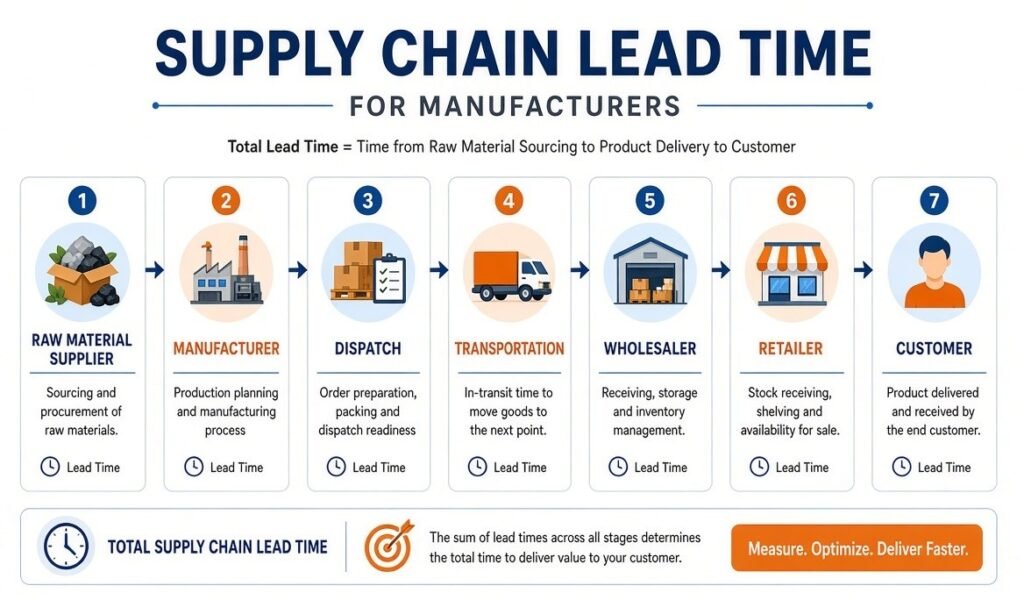
Once you know when the customer needs the product, calculate how long transportation will take.
Don’t think:
“I can dispatch when the festival is close.”
Think:
“If my customer needs the product by this date, when is the latest safe date I can dispatch it?”
And don’t calculate only the ideal transportation time.
Consider possible delays such as:
- Traffic
- Weather
- Regional disruptions
- Loading delays
- Route issues
- Holiday congestion
- Carrier capacity
- Documentation or operational delays
A manufacturer should therefore leave some safety margin instead of planning around the perfect scenario.
3. WORK BACKWARD FROM DISPATCH TO PRODUCTION
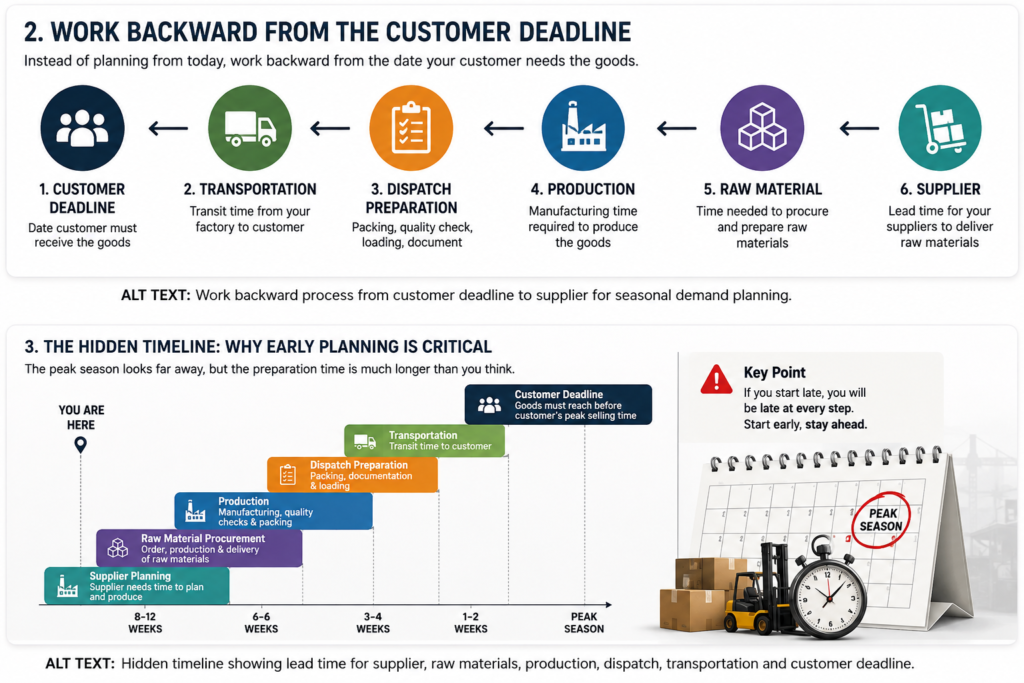
After calculating transportation, the next question is:
“How long will I need to manufacture the required quantity?”
Production planning is not simply about machine capacity.
You may need time for:
- Raw-material availability
- Production scheduling
- Labour
- Multiple product categories
- Quality checking
- Packing
- Carton preparation
- Finished-goods movement
- Unexpected production delays
If you sell multiple models, colours and sizes, the complexity becomes even greater.
Producing one product in large quantities may be relatively straightforward.
Producing many different products according to different customer requirements requires much more planning.
4. RAW MATERIALS HAVE THEIR OWN LEAD TIME
This is where seasonal forecasting becomes even more important.
A manufacturer is not necessarily the first link in the supply chain.
Your raw-material supplier may also need time to:
Purchase materials
↓
Manufacture or process them
↓
Prepare your order
↓
Dispatch
↓
Deliver to you
So when a manufacturer waits until the last moment to place a raw-material order, the delay doesn’t begin with the manufacturer.
It may already exist further upstream.
This creates a chain reaction.
Supplier delay
↓
Raw material arrives late
↓
Production starts late
↓
Dispatch moves late
↓
Transportation gets compressed
↓
Customer receives stock late
By the time the problem becomes visible, there may be very little time left to fix it.
5. FORECAST DEMAND BEFORE YOU HAVE PERFECT INFORMATION
One of the hardest parts of seasonal planning is that manufacturers usually have to make decisions before they know exactly how much customers will buy.
You cannot wait for perfect information.
You have to make a reasonable forecast using the information available to you.
Demand forecasting helps businesses make informed decisions when future demand is uncertain.https://www.mdpi.com/2071-1050/15/9/7399?utm_source=chatgpt.com
Some useful inputs include:
- Previous seasonal sales
- Previous year’s product performance
- Current buyer discussions
- Existing orders
- Early-season demand
- Product trends
- Customer feedback
- Market conditions
- Production capacity
- Supplier capacity
- Transportation lead times
The objective isn’t to predict the future perfectly.
The objective is to make a better decision early enough to prepare.
One of the most useful inputs for forecasting is understanding seasonal business demand from previous seasons.https://junedsiddiqui.com/seasonal-business-demand/?utm_source=chatgpt.com
6. FORECAST BY PRODUCT, NOT JUST BY TOTAL QUANTITY
A manufacturer shouldn’t only ask:
“How many units will I sell?”
A better question is:
“Which products will customers want, and in what quantities?”
For example, a business may have:
- Best-selling products
- Slow-moving products
- New products
- Seasonal products
- Different price ranges
- Different colours
- Different sizes
- Different customer segments
If you forecast only the total quantity, you may end up with the wrong product mix.
You could have plenty of inventory and still miss the opportunity because the products customers actually want are unavailable.
7. PRODUCTION CAPACITY MUST MATCH THE FORECAST
Demand forecasting and production planning should work together.
Suppose your forecast suggests that seasonal demand could increase significantly.
The next question is:
“Can my current production capacity handle that demand within the available time?”
You need to consider:
- Existing production commitments
- Available labour
- Machine capacity
- Working hours
- Production bottlenecks
- Raw-material availability
- Quality-control capacity
- Packaging capacity
If demand is higher than your production capacity, you need to identify that before the peak season.
The earlier you identify the gap, the more options you have.
8. CASH FLOW IS PART OF SEASONAL FORECASTING
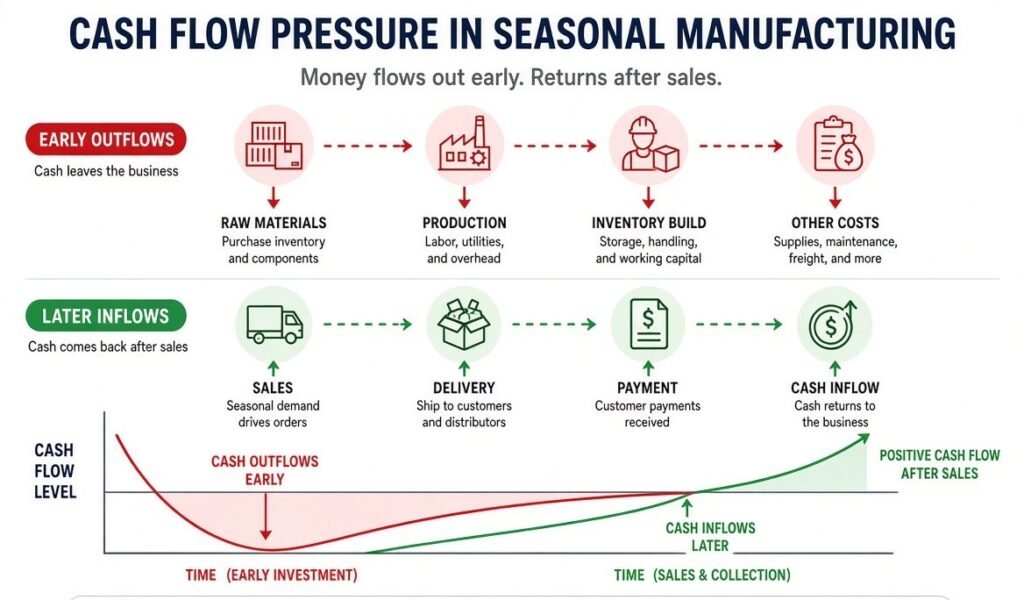
There is another part of seasonal preparation that is often overlooked:
Cash flow.
A manufacturer may need to purchase raw materials and produce inventory before receiving the final payment from customers.
That means seasonal growth can require additional working capital.
You may have:
Raw-material payment
↓
Production cost
↓
Packaging
↓
Transportation
↓
Customer credit period
↓
Payment received
The business may eventually make a profit, but it still needs enough cash to survive the period between spending and collecting.
Therefore, a seasonal forecast should not only answer:
“How much might we sell?”
It should also answer:
“How much cash will we need to prepare for that demand?”
9. BUILD A SAFETY BUFFER
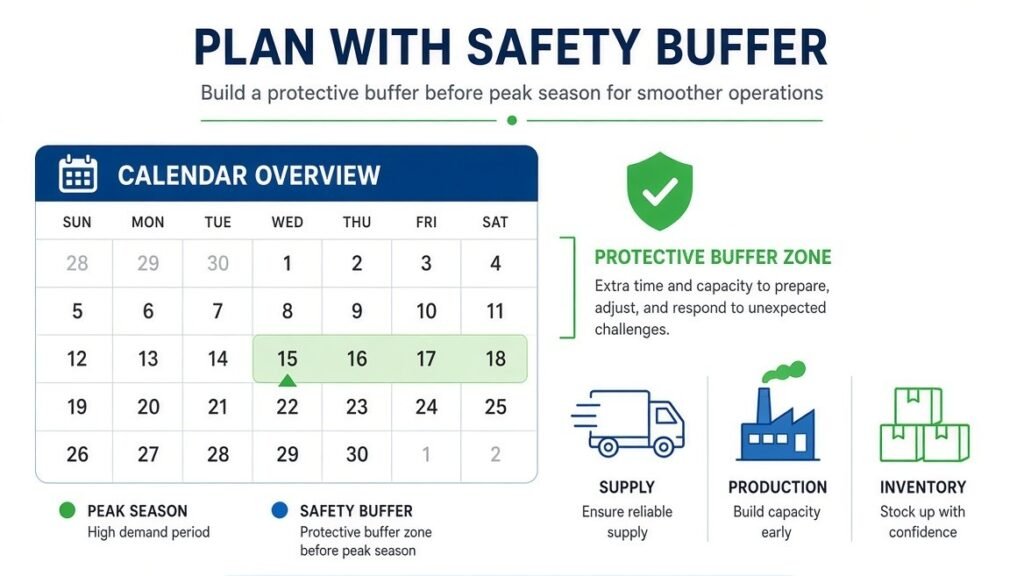
Forecasts can be wrong.
Transportation can be delayed.
Demand can be higher than expected.
A supplier can face a production problem.
Your own production can slow down.
This is why a good seasonal plan should include some safety margin.
The exact buffer will depend on the industry, product, lead time, cost of inventory and reliability of the supply chain.
The goal is not to create excessive inventory.
The goal is to avoid planning so tightly that one small delay can destroy the entire seasonal opportunity.
A SIMPLE BACKWARD PLANNING FRAMEWORK
A manufacturer can use this simple framework before every major seasonal period.https://docs.oracle.com/en/cloud/saas/supply-chain-and-manufacturing/26b/faupc/how-backward-scheduling-and-order-dates-are-calculated.html?utm_source=chatgpt.com
STEP 1 — IDENTIFY THE PEAK SELLING PERIOD
When will customers actually need the product?
STEP 2 — IDENTIFY THE CUSTOMER’S INVENTORY DEADLINE
When must the stock already be available?
STEP 3 — CALCULATE TRANSPORTATION LEAD TIME
How long will delivery take?
STEP 4 — CALCULATE PRODUCTION LEAD TIME
How long does manufacturing require?
STEP 5 — CALCULATE RAW-MATERIAL LEAD TIME
How long does your supplier need?
STEP 6 — ADD A SAFETY BUFFER
What could go wrong?
STEP 7 — CALCULATE WORKING-CAPITAL REQUIREMENTS
How much money needs to be committed before the sales cycle is completed?
STEP 8 — START PLANNING BACKWARD
Now you know when you actually need to begin.
A LESSON FROM MY FOOTWEAR MANUFACTURING BUSINESS
I have learned this through my own experience in footwear manufacturing and wholesale.
For me, a major festive season is not simply a date on the calendar.
It is a chain of deadlines.
When I look at a major seasonal opportunity, I have to think about:
Buyer planning
↓
Expected demand
↓
Product selection
↓
Raw materials
↓
Production
↓
Quality and packing
↓
Dispatch
↓
Transportation
↓
Customer’s selling period
↓
Final consumer demand
In my footwear business, I supply wholesale customers across different markets, including customers in South India.
That makes transportation and delivery planning an important part of my seasonal preparation.
I cannot wait until the festival is approaching before starting production.
My wholesale customers need their stock before their own peak selling period. Transportation also requires time, particularly when goods are moving long distances by road.
That means my practical deadline arrives much earlier than the festival itself.
And before I can manufacture the footwear, I have to think about raw materials.
My suppliers also need time.
This is why seasonal preparation can begin months before the consumer sees the peak demand.
This experience has taught me that forecasting is not about knowing the future with certainty.
It is about making decisions early enough that the business still has time to respond when reality is different from the forecast.
My experience running a footwear business has also taught me how external market pressures can affect pricing and planning.https://junedsiddiqui.com/junedsiddiqui-com-footwear-pricing-strategy/?utm_source=chatgpt.com
WHAT THIS TAUGHT ME ABOUT BUSINESS GROWTH
One of the biggest lessons I have learned is that business growth is not only about getting more orders.
It is about being capable of fulfilling those orders at the right time.
A business can have strong demand and still lose an opportunity if:
- Production starts too late
- Raw materials are unavailable
- Inventory is not planned correctly
- Transportation takes longer than expected
- Working capital is insufficient
- The wrong products are manufactured
- Customer deadlines are misunderstood
Growth therefore requires operational readiness, not just sales.
The ability to forecast demand, prepare capacity and deliver on time can be just as important as generating the order itself.
THE MANUFACTURER’S SEASONAL PLANNING CHECKLIST
Before a major seasonal period, I believe manufacturers should ask:
☐ What is the expected increase in demand?
☐ Which products are likely to sell the most?
☐ When does my customer actually need the stock?
☐ What is my transportation lead time?
☐ What is my production lead time?
☐ What is my raw-material lead time?
☐ Can my suppliers handle the additional demand?
☐ Do I have enough production capacity?
☐ Do I have enough working capital?
☐ What safety buffer do I need?
☐ What is my latest realistic dispatch date?
☐ What happens if demand is higher than expected?
☐ What happens if transportation or production is delayed?
FINAL THOUGHT
The biggest mistake a manufacturer can make is to look at the calendar and think:
“The season is still far away.”
Instead, ask:
“When does my customer need the product?”
Then work backward.
Customer deadline
↓
Transportation
↓
Dispatch
↓
Production
↓
Raw Materials
↓
Supplier
The consumer sees the season.
The retailer sees the selling opportunity.
The wholesaler sees the purchasing window.
But the manufacturer has to see the entire timeline.
The best time to prepare for peak demand is before the demand becomes obvious.
Forecast early.
Plan backward.
Build capacity.
Protect the delivery window.
That is how seasonal demand can become an opportunity for growth instead of a last-minute operational crisis.
ABOUT JUNED SIDDIQUI
Juned Siddiqui is a footwear entrepreneur and manufacturer documenting his experiences in manufacturing, wholesale, e-commerce, business growth and the practical use of AI in business.https://junedsiddiqui.com/about/
Through his Founder Journal and Business Growth articles, he shares lessons learned from running a real business and turning those experiences into practical lessons for other entrepreneurs and business owners.