Avoiding critical business growth mistakes is the ultimate objective for any founder, but rapid growth without operational control is dangerous. Millions of businesses shut down annually—not because they lacked a product or couldn’t land sales, but because they scaled their internal friction along with their revenue.
When a company scales prematurely, small operational flaws become massive organizational bottlenecks.
Whether you are running a physical supply chain, an e-commerce brand, or a digital agency, here are the five fatal growth mistakes that kill companies—and how modern operators avoid them.
1. Business Growth Mistakes: Confusing Top-Line Revenue with Net Profit
“Revenue is vanity, profit is sanity, but cash flow is reality.”
The single most common growth trap is chasing high top-line revenue numbers while ignoring shrinking profit margins. Scaling revenue from $100,000 to $1,000,000 means nothing if your customer acquisition costs (CAC), fulfillment expenses, and overhead explode at the exact same rate.
UNSUSTAINABLE GROWTH SYSTEMIC GROWTH
[Revenue Up 300%] [Revenue Up 300%]
│ │
[Costs Up 310%] [Costs Up 100%]
│ │
Result: Cash Crunch Result: Expanding Net Margin
The Fix:
- Track Direct Costs per Unit/Service: Know your exact gross margin after accounting for every single fulfillment fee, shipping cost, and software expense.
- Eliminate Low-Margin Clients/SKUs: Audit your catalog or client list quarterly and cut offerings that consume disproportionate labor for minimal margin.
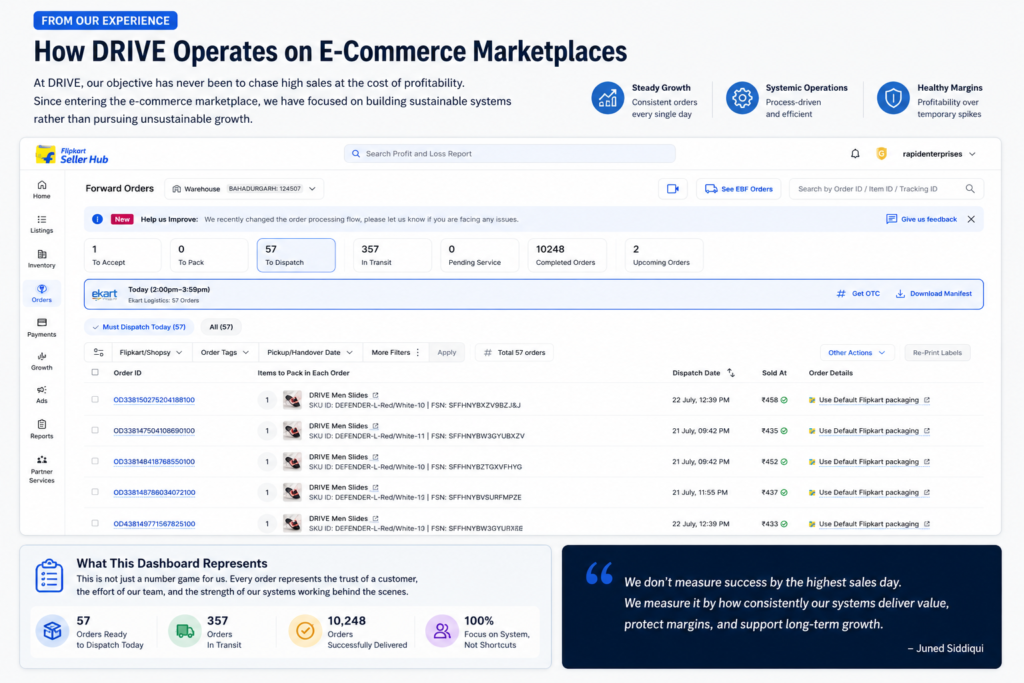
Real Example from Our E-commerce Operations
At DRIVE, we focus on sustainable growth rather than chasing sales at any cost. Our experience across online marketplaces has reinforced the importance of healthy margins, efficient operations, and disciplined execution.
2. Scaling Marketing Before Fixing Backend Systems
Pouring budget into customer acquisition while your operational backend is broken is like pouring water into a leaky bucket.
If your inventory synchronization is manual, your client onboarding requires endless back-and-forth emails, or your team is buried in spreadsheets, driving thousands of new visitors to your storefront will only accelerate customer dissatisfaction.
| Broken Backend Symptom | The Operational Solution |
| Frequent Stockouts or Inventory Delays | Real-time automated inventory sync across channels |
| High Customer Support Ticket Volume | Self-serve tracking & custom AI response workflows |
| Manual Data Re-Entry Between Tools | Webhooks & API integrations (Zapier, Make, custom scripts) |
The Fix:
Before increasing ad spend or sales outreach, stress-test your fulfillment and support capacity. Fix the leak before you turn on the firehose.
Our Manufacturing Unit is built around standardized workflows that reduce errors and improve consistency. Explore how we manage operations as we continue scaling.
3. Relying on “Hustle” Instead of Repeatable Systems (SOPs)
In the early days, a company survives on the founder’s personal energy. But relying on individual memory or late-night hustle is not a scalable strategy.
When processes exist only in the owner’s or key employees’ heads:
- Output quality becomes inconsistent.
- Delegating tasks to new hires becomes chaotic.
- Vacation or time off leads to operational halts.
The Fix:
Transition from a human-dependent operation to a system-dependent operation. Document Standard Operating Procedures (SOPs) for every recurring task using simple 2-minute screen recordings or structured checklists.
4. Premature Hiring & Uncontrolled Fixed Overhead
When work piles up, the default impulse for many founders is to immediately hire full-time staff. However, expanding headcount too early inflates fixed overhead and reduces agility during economic slow periods.
OLD SCHOOL METHOD MODERN OPERATOR METHOD
[Task Load Increases] [Task Load Increases]
│ │
[Hire Full-Time Staff] [Automate with Software/AI]
│ │
[High Fixed Overhead] [Outsource to Contractors]
│ │
[Fragile Cash Flow] [Scalable Variable Overhead]
The Fix:
Follow the Automate ➔ Outsource ➔ Hire rule:
- Automate: Can software, scripts, or AI handle this repetitive workflow?
- Outsource: Can a specialized contractor or agency handle it on a flexible basis?
- Hire: Only bring on full-time employees when the role requires deep context and directly generates ROI.
5. Ignoring Cash Reserves and Runway
A company can be profitable on paper and still go bankrupt if cash is tied up in inventory, unpaid invoices, or long payment cycles. Unpredictable cash flow destroys growing businesses before they can stabilize.
The Fix:
- Maintain a 3-to-6 Month Reserve: Keep operating expenses liquid in a dedicated cash reserve account.
- Tighten Debtor Cycles: Automate invoice payment reminders and enforce strict payment terms with B2B clients.
From Our Experience: In our drive manufacturing, we learned that strong sales don’t always mean healthy cash flow. Inventory purchases, supplier payments, and dealer credit cycles can create pressure even when orders are increasing.

Summary Checklist for Modern Operators
To ensure your business is built for long-term scalability, evaluate your operations against this quick checklist:
- [ ] Do you know your exact net profit margin per unit or service sold?
- [ ] Are your core operational tasks documented in repeatable SOPs?
- [ ] Is your customer fulfillment automated to handle a 3x surge in order volume?
- [ ] Are software integrations handling repetitive administrative data entry?
- [ ] Do you have at least 3 months of operating capital in reserve?
Companies rarely fail because of one dramatic mistake. More often, they fail because small operational problems compound as they grow. Sustainable growth comes from building systems, protecting cash flow, and making disciplined decisions. Focus on creating a business that can scale without depending on constant firefighting.
Looking to build scalable systems for your business?
Explore our operational frameworks across AI & Automation, or reach out directly on our Contact Page to discuss optimizing your growth strategy.